CRYPTO CASINORAKEBACKRun the numbersHow crypto casino rakeback works — formulas, rates and real examples.
Rakeback is not one universal product. The same word can describe a share of theoretical house edge, a direct turnover rebate, a personalised VIP return or a loss-based payment. The denominator decides what the percentage is worth.
Short answer: rakeback only makes sense when the denominator is visible.
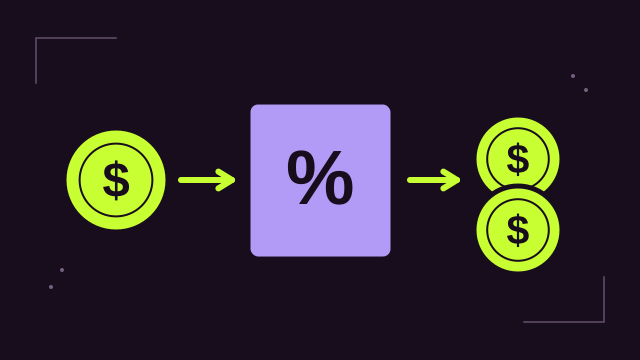
A transparent rakeback reward multiplies qualifying play by a stated base and rate. For house-edge rakeback, the usual model is turnover × game house edge × rakeback percentage. A 5% reward on $10,000 of play at a 4% edge returns $20—not $500.
Its public help article exposes the house-edge formula and a worked example.
Compare transparent programsThis page answers one specific question.
What rakeback is, which bases operators use and how to calculate the cash result.
It does not rank casinos or audit one operator’s complete VIP program.
Compare transparent programsFour rewards can share one label and still calculate differently.
Follow the value from qualifying activity to withdrawable balance. The point where the formula branches is the denominator—not the advertised percentage.
Turnover × game edge × reward share$10,000 × 4% × 5% = $20

Eligible stake × direct rate$10,000 × 0.20% = $20
Settled eligible loss × cashback rate$800 × 10% = $80
Qualifying activity × conversion valueUnknown until conversion is published
Three calculations that expose the four calculation families mechanics.
Each example holds unrelated variables still, so the page can test one four calculation families rule at a time. Live eligibility and account conditions remain separate inputs.
$10,000 × 4% × 5%$20Equivalent to 0.20% of turnover.
$10,000 × 0.20%$20Same result, but only if all wagers contribute fully.
$800 eligible loss × 10%$80Pays from settled loss, not from total wagering.
Identify what the advertised percentage multiplies.
“Five percent rakeback” is incomplete without its base. If it means five percent of a four-percent house edge, the effective return is 0.20% of turnover. If it means five percent of turnover, the value is twenty-five times larger.
Personalised systems add another unknown: the operator may calculate theoretical loss internally without publishing the account multiplier. Treat that result as unpriceable until the dashboard shows the inputs.
- House-edge share: wager × edge × rate
- Turnover share: eligible wager × direct rate
- Lossback: eligible net loss × cashback rate
- Points: activity × conversion value
Apply contribution, exclusions and the qualifying clock.
A qualifying wager is not always the amount shown in bet history. Baccarat may earn zero, live casino may contribute a fraction, and sports bets can require minimum odds or settlement before the reward is counted.
The measurement window matters most for loss-based rewards. A winning session later in the week may offset an earlier loss before weekly cashback is calculated.
Source 2: Bitsler — RakebackSeparate earned value from withdrawable value.
Claimable, credited and withdrawable are three different states. Some operators split rewards between cash and a calendar; others add wagering or a short claim deadline.
Our calculators show immediate cash, delayed cash and bonus value separately. That makes a smaller direct reward comparable with a larger but restricted one.
Source 3: Stake — What is rakeback?Use rakeback to measure cost, never to justify more play.
Rakeback reduces a fraction of expected casino cost. It does not remove the house edge, overcome volatility or guarantee that a session ends ahead.
Set the play budget first, calculate the reward second, and never increase wagering merely to reach a tier or recover a loss.
Source 4: Duelbits — Rakeback BitsThree formulas, captured at the source.
These records illustrate different denominators. Their captions identify the exact mechanic each image supports.

What this supports: four calculation families. The linked operator help capture supplies the rate mechanics used here.
Open full evidence file
What this supports: four calculation families. Rate, eligible products and official BTC example.
Open full evidence file

What this supports: four calculation families. Official casino context for the four-part reward system.
Open full evidence fileChoose the calculator that matches the denominator.
House edge, turnover and net loss belong in different inputs. Start with the operator’s wording, then run the corresponding model.
Documents used to define the four formula families.
The regulatory material defines RTP context; operator help pages supply the actual reward mechanics used in the examples.
RTP is a long-run average, not a session promise.
retrieved Checked 2026-09-0802Bitsler — RakebackPublished house-edge formula and worked example.
retrieved Checked 2026-09-0803Stake — What is rakeback?Casino, poker and sports calculation bases.
retrieved Checked 2026-09-0804Duelbits — Rakeback BitsFour-part reward schedule.
restricted Checked 2026-09-08One dated record, no invented update trail.
- Current review
Initial formula guide published after comparing house-edge, turnover, lossback and points models.
How crypto casino rakeback works — formulas, rates and real examples: FAQ.
01How is crypto casino rakeback calculated?
The clearest model is qualifying turnover multiplied by game house edge and then by the published rakeback share. Other casinos use direct turnover, points or net loss.
02Is 5% rakeback equal to 5% of my bets?
Usually not. If the rate is a share of house edge, a 5% headline can equal only 0.05%–0.25% of turnover depending on the game.
03Can rakeback pay after a winning session?
Yes, when it is based on theoretical house edge or turnover rather than actual net loss.
04Does every casino game earn rakeback?
No. Exclusions and reduced contribution commonly apply to baccarat, live casino, sports, bonus play or selected providers.
05Is rakeback real cash?
Sometimes. Verify whether it enters cash balance, a bonus wallet, a delayed calendar or requires wagering.
06Can rakeback make casino play profitable?
No. It can reduce expected cost, but the remaining house edge and short-term volatility still favor the operator.
07Why does the denominator matter more than the headline rate?
Because 5% of house edge can be a fraction of one percent of turnover, while 5% of turnover is twenty-five times larger at a 4% edge.
08What should I save before joining a program?
Save the rate, formula, eligible games, tier requirement, claim timing and cash treatment with the retrieval date.