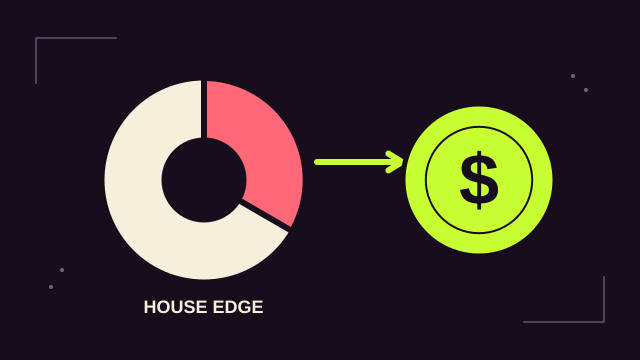
CRYPTO CASINORAKEBACKRun the numbersHouse-edge rakeback explained — turn the percentage into real cash.
House-edge rakeback returns a fraction of the casino’s theoretical advantage, not a fraction of every wager. It is one of the fairest reward models to compare when the operator publishes both the game edge and the reward share.
Short answer: convert RTP to edge before applying the rakeback share.
Effective turnover return = game house edge × rakeback share. At 5% rakeback, a 1% edge produces a 0.05% turnover return; a 5% edge produces 0.25%. The higher reward on the riskier game does not make that game cheaper overall.
This page answers one specific question.
How a share of theoretical house edge becomes an effective percentage of turnover.
It is not a general explanation of cashback or an operator ranking.
See the RTP adjustmentThe same 5% reward changes with the game edge.
The bars compare effective turnover return and the much larger residual edge. More rakeback cash on a risky game does not make that game cheaper.
Original edge 5% share returned
Three calculations that expose the house-edge conversion mechanics.
Each example holds unrelated variables still, so the page can test one house-edge conversion rule at a time. Live eligibility and account conditions remain separate inputs.
$25,000 × 1% × 5%$12.50Expected casino cost before reward: $250.
$25,000 × 4% × 5%$50More reward, but expected casino cost is $1,000.
4% × (1 − 5%)3.80% edgeThe reward trims the edge; it does not reverse it.
The formula prices the game’s expected cost, not your actual result.
Theoretical loss is turnover multiplied by the game’s mathematical house advantage. The account can win $2,000 in one session and still earn house-edge rakeback because the reward follows expected value, not realised loss.
That distinction makes house-edge rewards smoother than cashback, but only if the casino uses a disclosed edge and includes the game.
Source 1: UKGC — House edge and RTPTable-game edge depends on the rules and how you play.
A blackjack figure usually assumes a defined basic strategy and rule set. Roulette differs between single-zero and double-zero variants. Sportsbook margin is embedded across both sides of a market.
Do not import a generic web estimate when the operator publishes its own factor. The operator’s reward table controls the credited amount.
- Confirm game variant
- Check strategy assumption
- Use operator contribution table
- Separate side bets and bonus features
A larger cash reward can accompany a worse underlying bet.
On $10,000 turnover, 5% of a 5% edge returns $25; the same share of a 1% edge returns $5. The first game still carries $475 expected cost after rakeback versus $95 on the second.
Rank programs using the effective return for the game you actually play, then keep the residual edge visible.
Source 3: Bitsler — Rakeback formulaReject any house-edge claim that hides one side of the multiplication.
A published reward rate without a game edge cannot be reproduced. A game edge without the account’s share is equally incomplete. Personalised formulas should receive lower confidence until both values appear in the player dashboard.
Save the terms and date because operators can revise contribution factors without changing the marketing headline.
Source 4: Cloudbet — Rakeback rewardsOperator pages that expose an edge-based calculation.
Each capture is tied to a formula or rate table rather than a generic casino homepage.
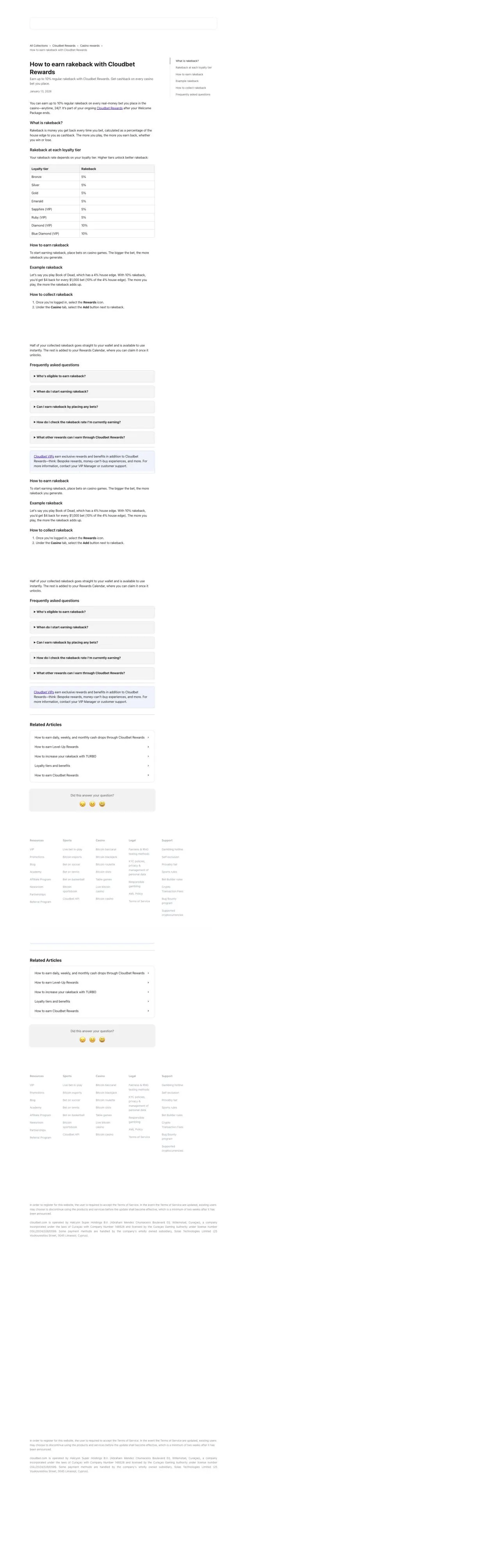
What this supports: house-edge conversion. The linked operator help capture supplies the rate mechanics used here.
Open full evidence file
What this supports: house-edge conversion. Primary current evidence for 5–10% of house edge.
Open full evidence file
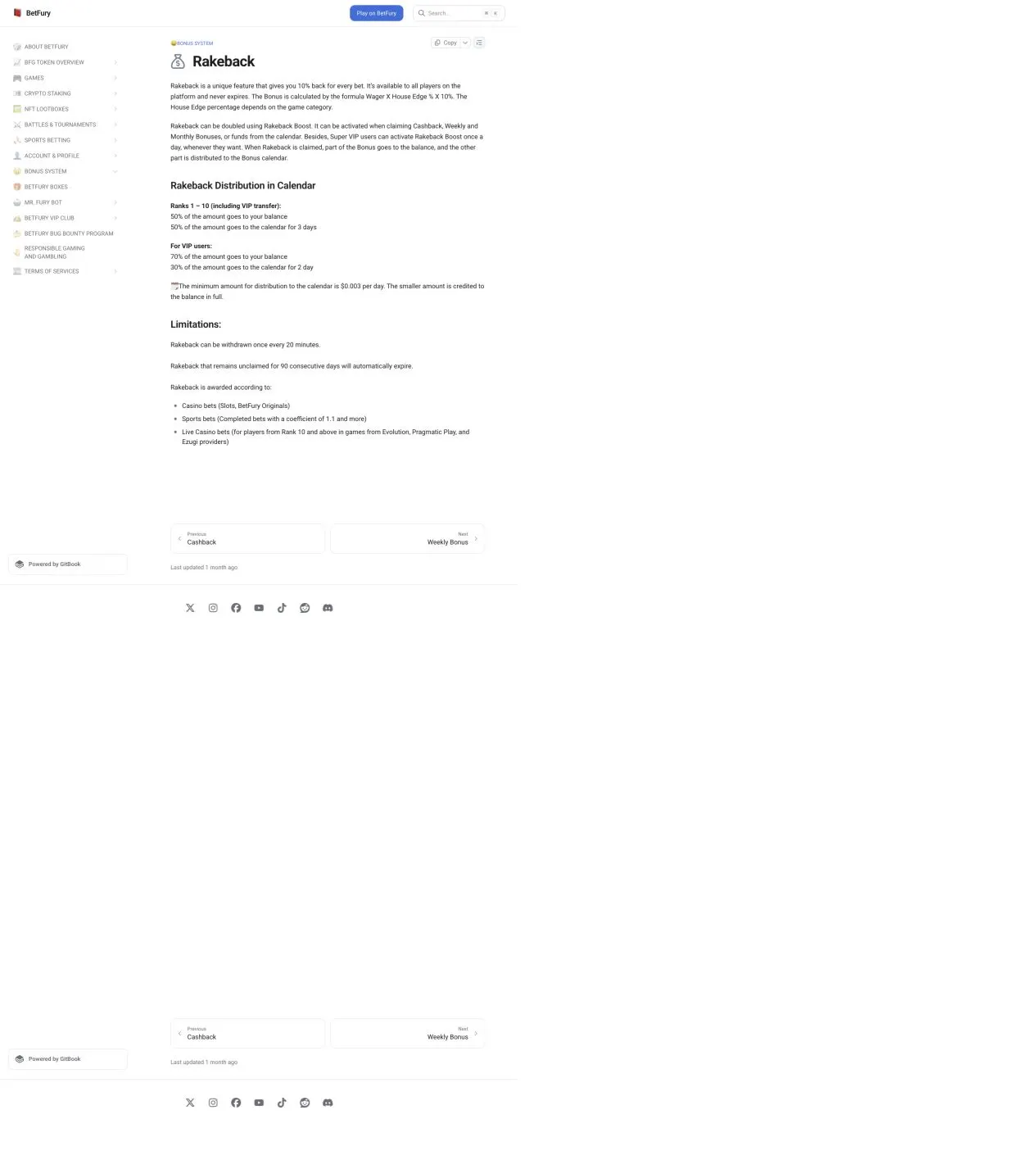
What this supports: house-edge conversion. Rate, standard/VIP access and claim frequency.
Open full evidence fileConvert the advertised share into an effective rate.
Use the game edge and the published share together; never enter the headline percentage as a direct turnover rebate.
RTP definitions and operator edge formulas.
The regulatory sources establish the edge/RTP relationship; the operator pages show how reward systems apply it.
Regulatory explanation of long-run RTP and casino advantage.
retrieved Checked 2026-09-0802UKGC — Game information standardGames should expose RTP, edge or probability information.
retrieved Checked 2026-09-0803Bitsler — Rakeback formula5% share of house edge.
retrieved Checked 2026-09-0804Cloudbet — Rakeback rewards5–10% tiered house-edge share.
restricted Checked 2026-09-08One dated record, no invented update trail.
- Current review
Initial edge model published with 1%, 4% and 6% worked scenarios.
House-edge rakeback explained — turn the percentage into real cash: FAQ.
01What is house-edge rakeback?
It returns a published share of the game’s theoretical casino advantage: turnover × house edge × rakeback percentage.
02What does 5% of house edge mean?
It means the reward is 5% of theoretical loss, not 5% of turnover. On a 4% edge, the effective turnover return is 0.20%.
03Why does a high-edge game earn more rakeback?
Because the theoretical casino revenue is larger. The player still faces a greater expected cost after the reward.
04Is house edge the same as RTP?
They are complements in a simple game: a 96% theoretical RTP corresponds to roughly a 4% house edge.
05Does short-term RTP affect my rakeback?
Normally the published theoretical edge is used, not the realised return in one session.
06Which operators publish house-edge rakeback?
Current official material documents this structure at Bitsler, Stake, Cloudbet, BetFury, Duelbits and several others in our database.
07Can two games at the same casino earn different cash rakeback?
Yes. Under an edge-based formula, different house edges and contribution factors can produce different effective turnover returns.
08What if the casino does not publish the game edge?
Treat the cash estimate as a range or unknown until the exact RTP, edge or operator factor can be verified.