18+ ONLYREWARDS CHANGE. NUMBERS DON’T LIE.HOW WE SCORE
RTP × REWARD / REAL COST

How RTP changes effective rakeback — and your remaining house edge.

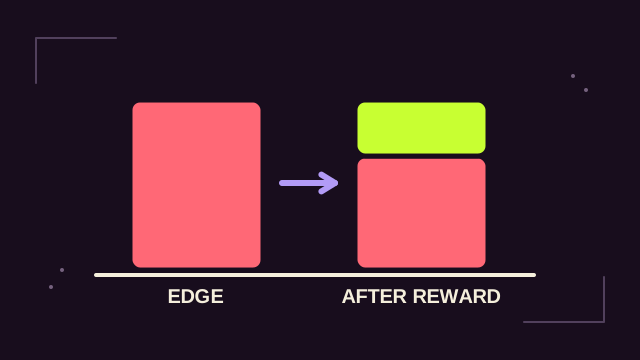
RTP describes the theoretical share returned as prizes over a very large number of plays. House edge is approximately 100% minus RTP. A house-edge rakeback rate therefore pays more cash on lower-RTP games—but those games also cost more in expectation.

Reviewed 08 Sep 20264 primary referencesConfidence A · Current primary trailWorked examples included
FORMULA

Short answer: rakeback returns part of the edge; it does not replace RTP.

Adjusted house edge = (100% − RTP) × (1 − rakeback share). A 96% RTP game has a 4% edge; 5% rakeback reduces that edge to 3.80%, equivalent to 0.20% of turnover returned.

Run the full calculator

Model turnover, RTP, contribution and reward cash together.

Read the edge formula
01 / 96% RTP4% house edgeChecked 08 Sep 2026
02 / 99% RTP1% house edgeChecked 08 Sep 2026
03 / 5% share on 4% edge0.20% turnoverChecked 08 Sep 2026
04 / 10% share on 4% edge0.40% turnoverChecked 08 Sep 2026
05 / RTP timescaleVery large sampleChecked 08 Sep 2026
06 / Session resultCan vary widelyChecked 08 Sep 2026
SEARCH INTENT / SCOPE

This page answers one specific question.

Included

How a cash-like rakeback reward changes theoretical total return and residual edge.

Kept separate

It does not predict session results or alter the RTP published by the game provider.

Read the edge formula
INTERACTIVE RTP LAB

Change RTP and rakeback to see the residual house edge.

The calculator keeps game RTP, reward return and adjusted theoretical RTP in separate lines.

GAME EDGE4.00%
TURNOVER RETURN+0.20%
ADJUSTED THEORETICAL RTP96.20%
3.80% residual edge
WORKED MATH / RTP-ADJUSTED RETURN

Three calculations that expose the RTP-adjusted return mechanics.

Each example holds unrelated variables still, so the page can test one RTP-adjusted return rule at a time. Live eligibility and account conditions remain separate inputs.

96% RTP4% edge × 5% share0.20% return

Adjusted theoretical RTP becomes 96.20%.

99% RTP1% edge × 5% share0.05% return

Smaller reward but lower residual cost.

94% RTP6% edge × 10% share0.60% return

Adjusted edge is still 5.40%.

01
RTP BASICS

RTP is a long-run design figure, not a refund forecast.

The UK Gambling Commission explains that RTP is an average achieved over significant play, not the amount a player should expect back in one session. Volatility determines how far short-term results can move around that average.

Do not add rakeback to a single session result and call it “actual RTP.” Use it to adjust theoretical cost.

Source 1: UKGC — Return to player
02
THE ADJUSTMENT

Rakeback returns only a fraction of the missing RTP.

For a 96% RTP game, the casino edge is 4%. Returning 5% of that edge adds 0.20 percentage points to theoretical return, not five points.

The adjusted theoretical RTP is 100% minus edge × (1 − reward share).

  • Find published game RTP
  • Convert to edge
  • Apply eligible contribution
  • Multiply edge by rakeback share
  • Subtract any wagering friction
Source 2: UKGC — Calculating actual RTP
03
GAME SELECTION

Do not choose a worse game merely because it earns more.

A 94% RTP slot at 10% house-edge rakeback has an adjusted 94.6% theoretical return. A 99% RTP game with no reward is still theoretically cheaper at 99%.

Reward hunting can invert the decision if the player focuses on the cash credit and ignores the much larger base edge.

Source 3: UKGC — Game information
04
REALITY CHECK

Volatility dominates small rakeback differences in short sessions.

A 0.10-point effective reward difference is measurable over large turnover but trivial beside normal session variance.

Use the calculation for program comparison and budgeting—not as a prediction or reason to increase stake size.

Source 4: Bitsler — Rakeback
VISUAL EVIDENCE / RTP-ADJUSTED RETURN

Formulas used to connect published RTP with reward return.

The captures support edge-based reward mechanics; the RTP itself must still be checked at game level.

Stake Help Center page explaining the 3.5 percent rakeback formula — evidence used for RTP-adjusted return
CAP-01 · StakeCurrent rakeback formula

What this supports: RTP-adjusted return. Rate, eligible products and official BTC example.

Open full evidence file
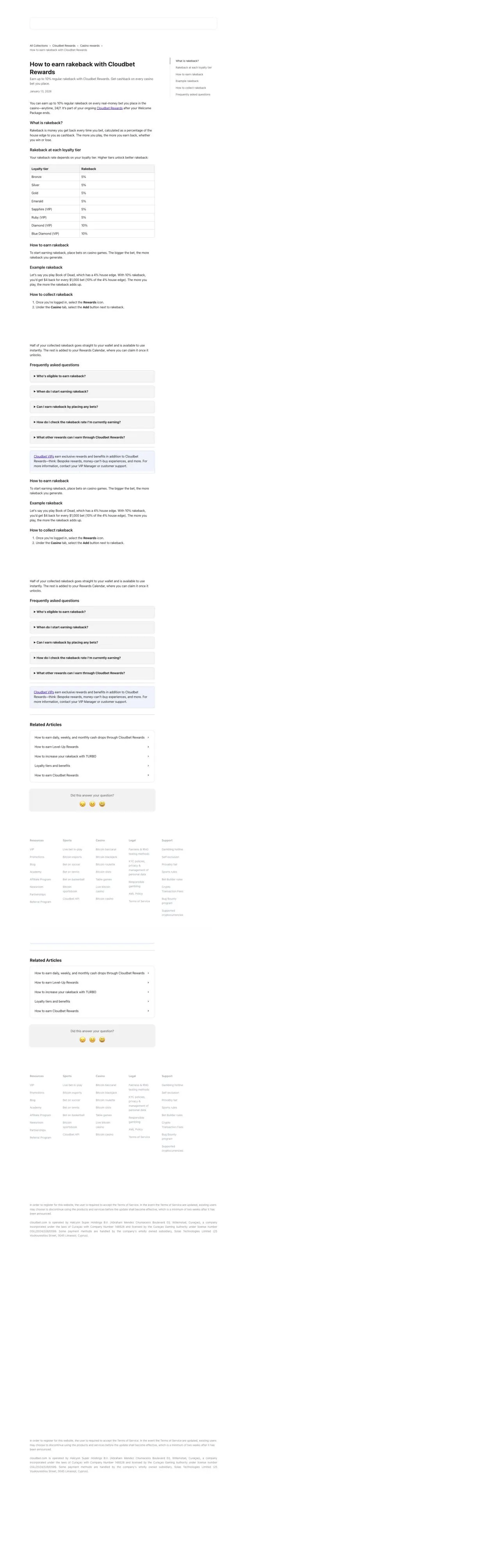
Bitsler official rakeback evidence reviewed for this guide — evidence used for RTP-adjusted return
CAP-02 · BitslerBitsler source capture

What this supports: RTP-adjusted return. The linked operator help capture supplies the rate mechanics used here.

Open full evidence file
Cloudbet Rewards help page showing rakeback rates by VIP tier — evidence used for RTP-adjusted return
CAP-03 · CloudbetRate table and formula

What this supports: RTP-adjusted return. Primary current evidence for 5–10% of house edge.

Open full evidence file
USE THE RTP-ADJUSTED RETURN DATA

Model total theoretical return without hiding volatility.

Use the lab for a quick comparison, then enter real turnover and contribution in the full calculator.

SOURCE REGISTER / PER-RECORD STATUS

Primary definitions for RTP and edge-based rewards.

Regulatory RTP material anchors the mathematics; the operator formula supplies the reward share.

RTP-ADJUSTED RETURN DOCUMENT HISTORY

One dated record, no invented update trail.

  1. Current review

    Initial RTP adjustment guide published with interactive residual-edge scenarios.

  2. Scheduled RTP-adjusted return refresh

    Next pass: re-open the cited records and recalculate this page’s evidence grade.

DIRECT ANSWERS / 8 QUESTIONS

How RTP changes effective rakeback — and your remaining house edge: FAQ.

01Does rakeback increase RTP?

It increases the player’s theoretical total return when the reward is cash-like, but it does not alter the game software’s published RTP.

02How do I convert RTP to house edge?

For a simple house-banked game, subtract RTP from 100%. A 96% RTP corresponds to roughly a 4% edge.

03What is the effective RTP with 5% rakeback?

On a 96% RTP game, 5% of the 4% edge adds 0.20 points, producing a theoretical 96.20% total return before restrictions.

04Does higher rakeback mean lower expected loss?

Only after accounting for the starting game edge. A low-RTP game can pay more rakeback cash and still have a much higher residual edge.

05Is actual RTP guaranteed over my session?

No. RTP is measured over very large numbers of plays; volatility can dominate short-term outcomes.

06Should I choose games by rakeback contribution?

Use contribution as one input, but compare the residual house edge and never increase risk solely to earn a reward.

07Can rakeback turn a negative-edge casino game positive?

Ordinary casino rakeback returns only a fraction of the house edge, so the adjusted theoretical return normally remains below 100%.

08Why can a lower-RTP game show more rakeback cash?

Its larger house edge creates a larger reward base, but the remaining expected cost is also larger.